Cross-Table Consistency Checks With Reconciliation Queries
Matching row counts masks data mismatches that reconciliation queries can catch.
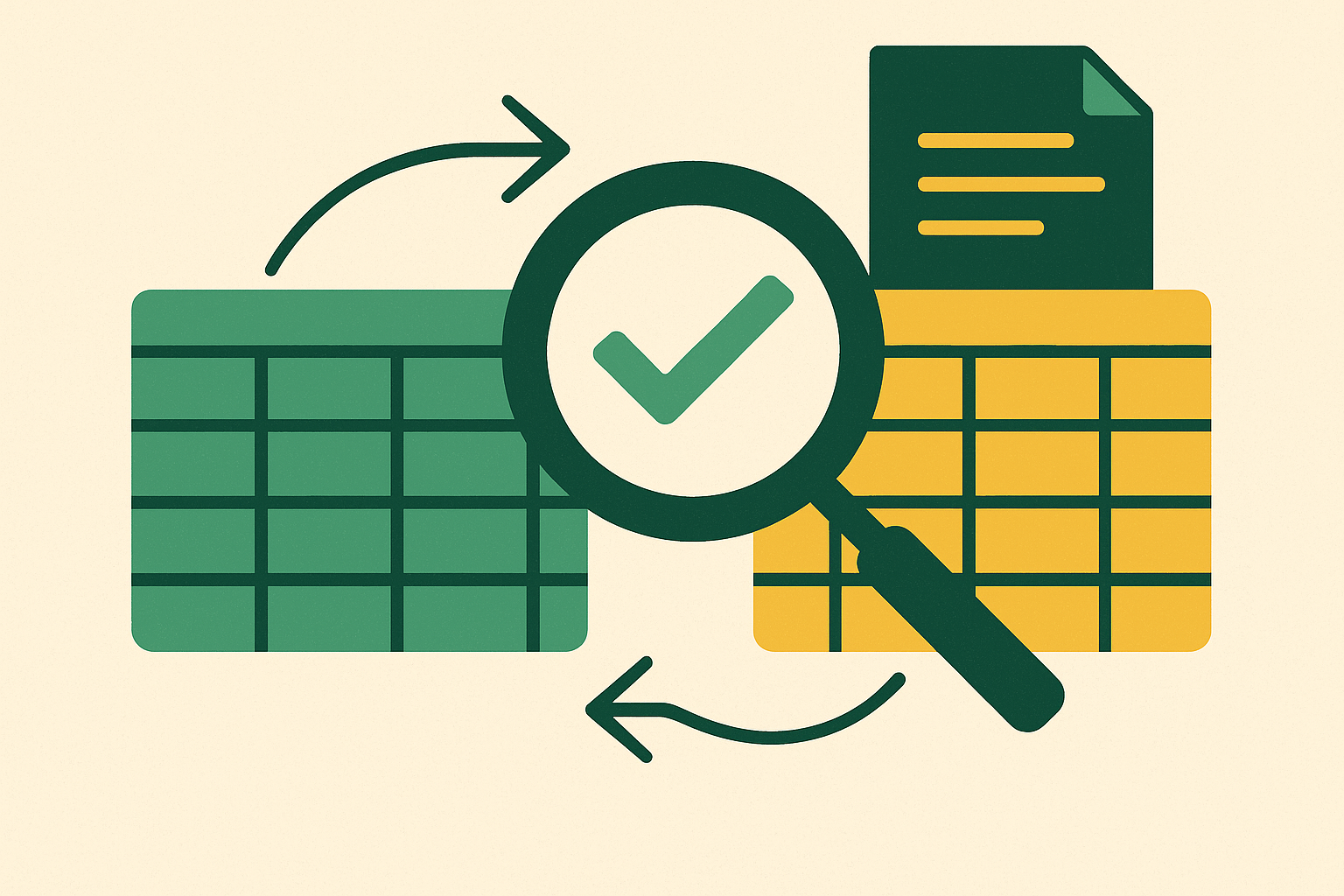
A row count that matches between two tables tells you almost nothing about whether those tables agree. Cross-table consistency is a harder problem than a quick count comparison suggests: two tables can hold identical row totals while one contains missing records, duplicated entries, shifted mappings, or aggregates that diverge from one another. The count still balances. The ledger does not.
The structural blind spot behind this failure sits between two concepts that sound similar but ask different questions. Data validation asks whether a record meets a rule: is the date formatted correctly, does the amount fall within an expected range, is the field populated. Data reconciliation asks something else: does this record, and the system it came from, agree with its counterpart in the system it moved to. A record can pass every validation rule a pipeline enforces and still disagree, in value or in existence, with the row it is supposed to match downstream. That gap is where financial closes go wrong, where customer records drift between a CRM and a data warehouse, and where executives end up with two different revenue numbers in two different dashboards, both technically "valid."
This is not a problem unique to finance. Organizations built fast pipes before they built reliable checks on what flows through them, and row-count matching became the easy proxy for correctness precisely because it is cheap to compute and easy to explain. It is the shallowest check available, so a full reconciliation posture needs to go further.
The five levels of cross-table consistency that reconciliation queries must cover
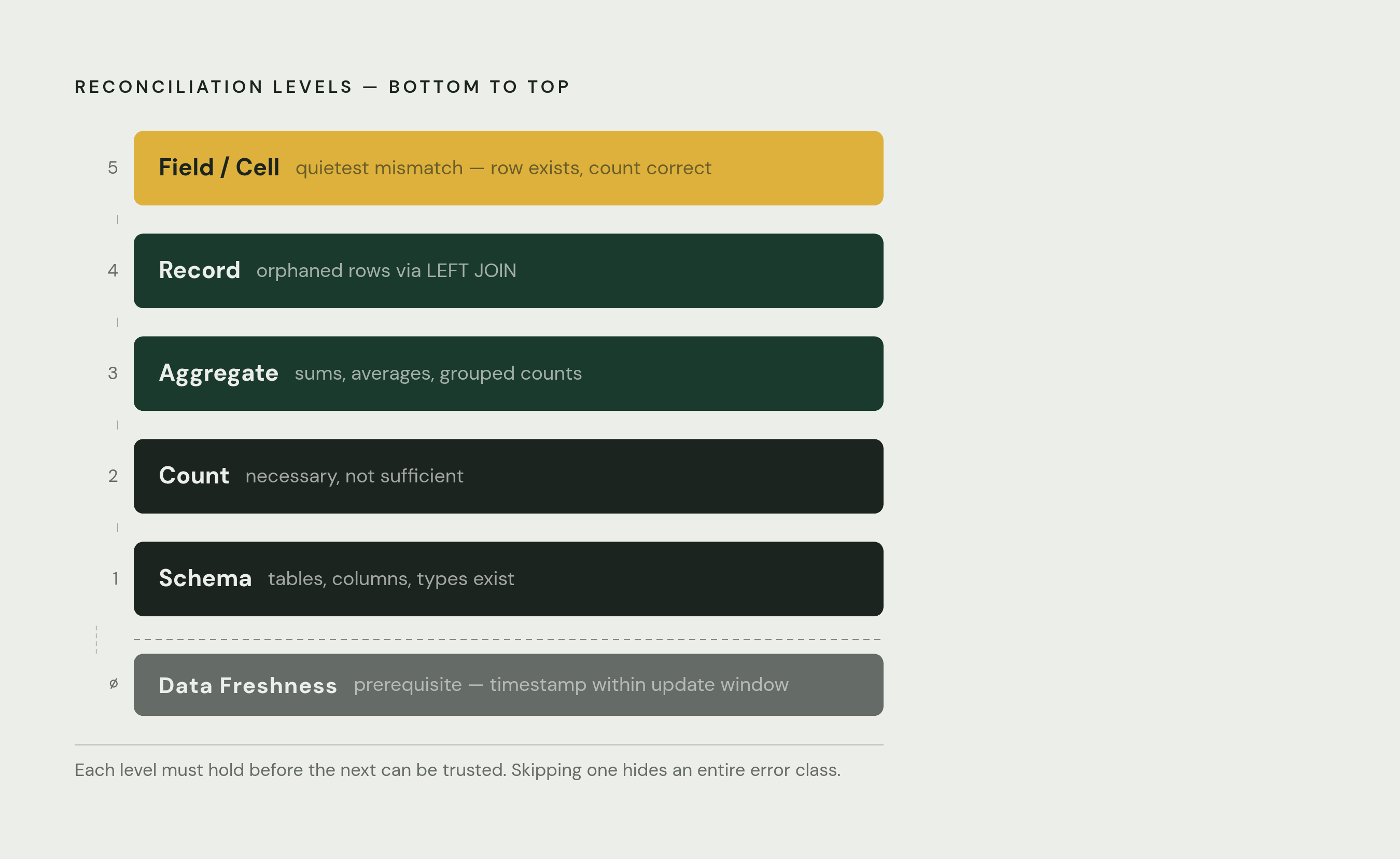
Reconciliation works as a ladder, not a checklist. Each level depends on the one below it holding true, and skipping a level does not save time; it hides a category of error until that error appears somewhere more expensive.
Schema reconciliation is the most basic check, asking whether the expected tables, columns, mappings, and data types actually exist where they're supposed to. At the top sits field- or cell-level reconciliation, which compares the actual values for every matched pair of records to confirm they agree.
The order matters because each level only means something if the level below it has already passed. Record-level and field-level checks only make sense once you know the counts and aggregates they're built on are sound.
Each level also fails differently, and those failure modes rarely look alike. Field-level mismatches are the quietest of all: values shift without leaving any structural trace, because the row exists, the schema is intact, and the count is correct.
Orphaned records deserve particular attention because of how silently they propagate. That means a child record with no matching parent can sit in a warehouse for months, feeding analytics and reports, without a single pipeline error ever firing. Nothing crashes. The number is just quietly wrong.
What ties these five levels together is a set of three questions that enterprise reconciliation exists to answer. Did everything that was expected to arrive actually arrive. Was anything changed that should not have been changed. And can every material difference between source and target be explained. A reconciliation program that cannot answer all three, using checks at all five levels, is not actually reconciling anything, it's spot-checking.
Constructing Reconciliation Queries: Schema Checks to Field-Level Comparison
Building reconciliation queries means moving from the most structural checks toward the most granular ones, because that order mirrors the dependency chain described above.
Count-level checks come next, and they need to be understood for what they are: necessary, not sufficient. COUNT(source) = COUNT(target) is an entry condition for the checks that follow, not a conclusion in itself. Passing it earns a table the right to move to the next level of scrutiny. It proves nothing on its own.
Aggregate checks compare totals, sums, averages, and grouped counts between source and target.
Record-level checks catch orphaned records that cloud warehouses will not catch on their own. A straightforward LEFT JOIN pattern does this work:
SELECT COUNT(*) AS orphaned_records
FROM child_table c
LEFT JOIN parent_table p ON c.parent_id = p.id
WHERE p.id IS NULL;
This is the pattern that catches shifted mappings and changed values when no count check and no schema check would ever have flagged anything:
SELECT t1.id, t1.value, t2.value
FROM table1 t1
JOIN table2 t2 ON t1.id = t2.id
WHERE t1.value != t2.value;
A sixth check underlies all five of the above: data freshness. A field-level comparison that passes against stale data is a false positive dressed as a clean result, agreement between two snapshots that were never current at the same time. Checking the latest timestamp against an expected update window should happen before any value comparison runs:
SELECT MAX(timestamp_field) AS last_update_time
FROM my_table;
Without that check first, a team can spend an afternoon confirming that two tables agree perfectly, only to discover both were frozen in place three days earlier.
Why the sequence in which checks run determines what they can actually catch
Running these checks in the wrong order produces results that look clean and aren't. A field-level pass against data that failed a schema check upstream, or against data that's gone stale, shows that nobody looked closely enough to notice the comparison was meaningless before it ran.
The medallion architecture offers a useful model for getting this right, not as a product to adopt but as a logic to borrow. The transition from a raw layer to a cleaned layer applies basic cleansing and deduplication. The transition from a cleaned layer to a curated layer applies business logic, aggregations, and joins. Each of those transitions functions as an explicit quality gate, and a failure at an earlier layer is meant to stop later checks from ever running against inputs that were already broken. Running a field-level comparison on curated-layer data that inherited a schema error from the raw layer doesn't just waste the check, it produces a false signal that something downstream is fine when the actual problem was never addressed.
Where a check sits in a pipeline is a design decision with real consequences, not a detail to leave to convenience. A check built into the pipeline itself can stop bad data from landing in the first place. A check that runs after the load can only report that the data already landed, for better or worse. Both have legitimate uses, but they serve different tables and different levels of risk tolerance, and conflating them leads teams to assume protection they don't actually have.
Gating, the practice of blocking a pipeline until a check passes, should be reserved for a small set of tables where a wrong row does more damage than a late table would: customer-facing exports, payments reconciliation, anything feeding a production model. Gates that misfire block the business they're meant to protect, so they need to be precise and few, not applied broadly out of caution.
Timing dependencies complicate sequencing further. The checks themselves ran in the correct sequence. The data they were checking had already been produced out of order, which no amount of correct check sequencing after the fact can repair.
Data contracts make sequencing binding instead of leaving it a set of informal expectations. Testing gets embedded across that lifecycle rather than bolted on after delivery; a sequence with embedded testing holds under pressure, while one without it only works when nothing unexpected happens.
Cross-Table Checks and Systems With Different Semantics
The hardest class of cross-table inconsistency has nothing to do with structure. It's semantic: the same word means two different things in two different systems, and no query pattern described above can detect that on its own.
Take a metric as ordinary as "monthly revenue." It might be calculated independently across a CRM, a data warehouse, a billing system, and a BI tool, each with its own calculation logic, its own refresh schedule, and its own quiet assumptions about what counts toward the total. The absence of a shared definition that all four systems were supposed to be using causes it.
Traditional validation frameworks check whether a value is present and whether it falls within an expected range. They do not, and structurally cannot, ask whether "customer" in a sales system means the same entity as "customer" in finance. That question sits entirely outside the scope of structural reconciliation, no matter how many levels of schema, count, aggregate, record, and field checks a team runs.
The CRM-to-revenue conflict is the clearest version of this problem at the go-to-market layer. When a CRM and a finance platform stop agreeing on basic figures, leadership loses trust in the numbers generally, and the disagreement driving that loss of trust is rarely a data type error. It's a definitional one, two systems counting different things and calling the result by the same name.
AI compounds this problem. A model trained to reconcile or summarize figures across systems does not know, on its own, that "Revenue" in a finance system excludes refunds while "Revenue" in a CRM does not. It treats both as the same metric, builds further analysis on top of that false equivalence, and produces an answer delivered with total confidence that happens to be wrong.
How Ownership Ambiguity Undermines Reconciliation
A technically correct reconciliation query that no one owns produces a detected discrepancy that simply sits there, unresolved, because detection without an owner is not the same as resolution.
Two schools of thought disagree about where that ownership belongs. Without alignment between those two schools, every executive question about a discrepancy still triggers the same manual reconciliation process, the same cross-department coordination, and the same avoidable cost, regardless of how good the underlying queries are.
Schema changes that cascade across teams expose this gap most sharply. When an upstream team changes an API or alters a schema without telling the teams downstream, reconciliation checks that were accurate the day before are suddenly comparing current data against a definition that no longer applies. The query hasn't broken. The world it was built to describe has moved out from under it, and nobody told the people running the check.
There's a real risk on the other side of this problem too: alert fatigue. Not every reconciliation failure deserves to block a pipeline or page an engineer at two in the morning. Treating every discrepancy as an equal-severity alert trains teams to ignore the alerts, defeating the purpose of running the checks. Exception-driven workflows route only the differences that actually need a human's attention, categorizing exceptions by severity and type before they ever reach someone's inbox.
A prerequisite underlies both problems: data lineage. When a model or a dashboard produces a number that looks surprising, the first question anyone should ask is where that number came from. If a metric cannot be traced back to its source, through every transformation it passed through, there is no way to validate it and no way to debug it when it's wrong.
Continuous, Automated Reconciliation as the Architecture for Enterprise Data Change Rates
At the volume and speed modern enterprise data moves, periodic manual reconciliation cannot catch discrepancies before they spread into reports, forecasts, and decisions built on top of them. Continuous, automated reconciliation is the baseline a stack needs to function.
Manual reconciliation carries a cost structure that compounds against the teams running it. Detecting and resolving an inconsistency after the fact costs far more than preventing it would have. When prevention fails, data teams spend a large share of their working hours finding inconsistencies, errors, and gaps.
The DataOps model shows what the alternative looks like in practice. Billing contracts get defined once. Tested pipelines then continuously produce a reconciled gold table, catching issues during pipeline validation itself rather than after a dashboard has already been published and an executive has already acted on it. That sequence lets leadership trust operating-income figures with a fraction of the manual verification the old process required.
Automation matters not just for the checks themselves but for what happens after a discrepancy is found. Workflows that detect, assign, and track issues without someone manually chasing them down stop being optional once an organization reaches a certain scale. If the fix loop still runs through email threads and manual follow-ups, the gap between what's broken and what's fixed grows faster than any team can close it by hand.
CRM and go-to-market systems make this concrete. A practical minimum check for this pipeline is a five-field cross-table audit, covering email, phone, job title, company name, and last enrichment date, flagging any record where more than two of those fields are missing or where the enrichment data is older than twelve months.
The broader shift underway is from static, hand-coded rules toward checks that adapt as schemas and business logic change. Traditional pipelines depend on rules written for a data landscape that no longer looks the way it did when the rules were written, and those rules struggle to keep pace with how quickly that landscape moves. The checks that detect anomalies dynamically and propose, or apply, fixes without waiting for a human to triage every single alert by hand are the direction worth building toward.
That's the logical endpoint of everything described above: an agentic data reliability layer that continuously monitors systems of record, CRMs and RevOps tools among them, watching for duplicates, missing fields, and cross-system inconsistencies, and proposing evidence-based fixes as they arise rather than after a quarter has already closed on numbers nobody fully trusted.