Mapping Legacy CRM Fields to Salesforce Objects Before You Touch the Export
Clean your source data and define field ownership before moving anything into Salesforce.
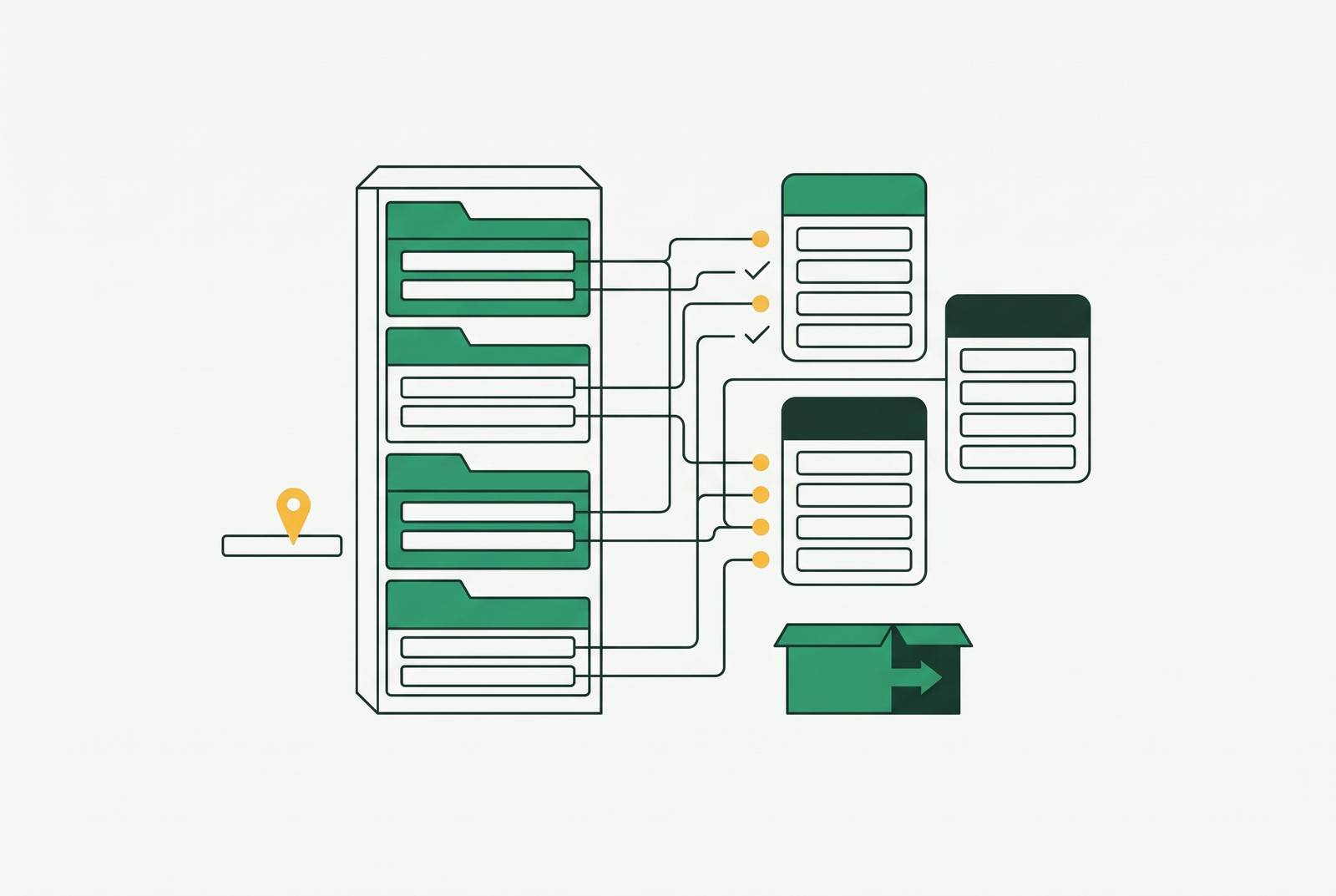
Mapping legacy CRM fields to Salesforce objects before export means deciding what the data means to the business as well as how to move it. Each field needs a defined purpose, an owner, and a destination that preserves its role in the business. Without those decisions, Salesforce inherits the legacy system’s unresolved problems.
Why the first migration question is usually the wrong one
Most teams begin by asking how to export everything. That question makes preservation the default before anyone has decided what deserves to survive. A mature CRM contains Accounts, Contacts, Leads, Opportunities, activities, cases, files, products, campaigns, custom objects, and years of history. Treating that estate as a file transfer reproduces its defects as readily as its useful records.
Teams should first decide what to retain, change, or leave behind. Data the business still uses needs migration and validation, while history worth keeping may belong in Salesforce or an archive, based on who needs access to it. Duplicate or obsolete records need cleaning or exclusion. Legacy-only configuration calls for redesign rather than copying, and old reports or temporary exports warrant archiving only if required. Those choices may change until the team knows what each field means and does.
Why process mapping must come before field mapping
“Customer Status” appears to offer a straightforward mapping opportunity. Yet sales may use it to mean an active opportunity, finance to mean a paying account, and support to mean a customer with a current service entitlement. The label conceals three incompatible definitions of the customer. Moving those values into a similarly named Salesforce field preserves the ambiguity.
The necessary sequence starts with documenting real workflows around lead qualification, opportunity stages, approvals, onboarding, customer service, renewals, reporting, and departmental handoffs. Those workflows reveal why a field exists, who changes it, and which decisions depend on it. Only then can the team decide whether to retain, redesign, or retire each legacy behavior. Field mapping follows that decision.
This process work also exposes ownership that a schema cannot show. Someone must determine whose definition governs and who is accountable when a migrated value is wrong. A field without a named owner or documented workflow is especially vulnerable to semantic drift, because its meaning can change without an agreed reference point. Technical compatibility makes the disputed value easier to transfer.
What field mapping actually requires — the six categories of decisions
Direct mappings link one source field to the destination field that matches it. Even for this simplest kind of mapping, the team must agree on types, lengths, and allowed values. Matching names alone does not establish compatibility. Transformation mappings go further by changing the representation, such as converting legacy free text into a standardized Salesforce picklist. The mapping must enumerate the source values, define how exceptions are handled, and document the transformation rule.
Splitting logic turns one field into several. Separating “Full Name” into First Name and Last Name looks simple until the source includes prefixes, suffixes, or single-name entries. The team needs rules for these cases because one pattern cannot be assumed to fit them all. Concatenation rules work the other way, joining several legacy address fields into one structured field where needed. Address mappings may also require separation, so the decision concerns the structure of the destination as well as the source.
Default value assignment sets values for destination fields that have no matching field in the source. Leaving a value null is still a decision, because downstream logic will inherit that absence. Conditional mapping adds routing based on source values, such as assigning enterprise accounts to a high-priority tier and others to standard. These business rules are part of the mapping file. Their correctness depends on the process definitions established before technical matching began.
Relationships matter in all six categories of decisions. Parent records must be in place before dependent records can be linked, and user mappings must be settled before record ownership can be assigned correctly. Load order is therefore an output of relationship mapping. Reserving a dedicated “Legacy Id” field on each object supports consecutive loading, including accounts before related contacts, and helps show what loaded where and what failed. That traceability helps the team track loads and failures when migration runs more than once.
What to clean in the legacy system before any field is mapped
Reliable mapping requires a source whose values can be interpreted consistently. Duplicate Accounts, inactive Contacts, inconsistent country values, invalid email addresses, missing ownership, and test records may all be technically importable. Importability is not a reason to retain them. Free-text fields that should be picklists also need normalization before their contents can support dependable transformation rules. Otherwise, the mapping encodes unresolved source defects into the destination.
The pre-mapping cleanup should cover duplicate detection and merge rules, required-field completeness, and email, phone, address, date, and currency formats. It should also make picklist values consistent and set standards for names. Account and Contact relationships require review, as do record ownership and inactive users. Before migration, the team needs to check consent and communication preferences, along with the rules for keeping historical data. This is a prerequisite for dependable mapping.
The source platform affects how much work that takes. Oracle Siebel CRM, desktop database tools, Lotus Notes, and custom-built systems can present format incompatibilities, limited automation, and poor data quality that demand extensive cleansing and normalization. The target is data sufficiently understood and standardized to support deliberate mapping decisions. Fixing dirty data after it enters Salesforce is substantially more expensive, while B2B contact data continues to degrade without maintenance, adding new errors to those imported.
How bad field decisions corrupt the revenue data that runs the business
An inconsistent “Employee Count” field shows how a small mapping defect can become a revenue problem. A value of “500” and a range of “500–1000” do not represent the same kind of information. If both pass through as interchangeable inputs, territory assignment rules, compensation models, and pipeline roll-ups that reference them become unreliable. The record can still look superficially complete.
Stale job title data can prevent a decision-maker from being reached, while missing employee count can keep an ICP account from being flagged. A buying signal may disappear from view because the field that should expose it was mapped to the wrong object. These are not merely reporting inconveniences. They limit what revenue teams can recognize and act on.
Trust erodes as those discrepancies accumulate across daily work. When staff stop believing that Salesforce reflects reality, the forecast still inherits the inaccuracies in its underlying records. Leaders then make resource and pipeline decisions using numbers that are partly fabricated by bad definitions or inconsistent values. The financial risk extends beyond the correction itself.
Why AI on top of a poorly mapped CRM makes every problem faster and larger
AI readiness raises the stakes because agents such as Agentforce act directly on CRM data at scale without a person double-checking every decision. Incomplete or inconsistent fields become inputs to autonomous action across the business. The rate of error is no longer bounded by how quickly people can work through records.
The “Customer Status” example illustrates the mechanism precisely. An agent routing a lead from a field with three incompatible definitions can make the wrong decision confidently. It can repeat that decision for every lead passing through the same logic until someone traces the problem to the original mapping. Automation acts on the field as represented in the CRM.
The same dependency applies when executives query data directly, agents replace workflow steps, buying signals drive outbound activity, or marketing scales without added headcount. These uses need semantic trust as well as fields with values in them. For migration teams with AI on the roadmap, mapping is therefore an AI infrastructure decision. Ongoing reliability platforms address the continuing version of this problem by monitoring semantic drift, null rates, and inconsistencies, with the ability to propose or apply fixes autonomously. That maintenance complements the original mapping decisions, which remain necessary.
How AI-assisted tools change the mechanics of field mapping — and what they still cannot do
Tamr’s AI-native approach moves schema mapping from work done entirely by hand toward automating much of it, with human experts left to review the rest. Boomi’s Suggest feature proposes field connections from patterns in a large indexed library of anonymized customer mappings. It groups suggestions into high, medium, and low confidence. These tools cut the work people must do to find likely matches. They do not establish that two similarly structured fields mean the same thing to the business.
Fivetran addresses a different part of the problem through schema drift handling. When a source renames a field, adds a column, or changes a data type, it automatically adjusts the destination schema. That protects against silent corruption caused by unnoticed structural changes between syncs. Structure and meaning remain separate questions, however. A schema adjustment cannot decide which department’s definition of “Customer Status” should govern.
The hybrid production model combines automated confidence scoring with selective human review. Mappings above a confidence threshold are auto-approved, while lower-confidence suggestions go to reviewers, particularly where relationships are complex or ambiguous. Human judgment still determines which of two status fields is the source of truth, how sensitive fields should be treated, and what a null means in each system.
Automation also helps spot schema changes, re-run failed jobs, and send alerts before a broken mapping reaches a dashboard or an AI model. Agentic AI builds on this with anomaly detection that runs on its own, root cause analysis that traces errors to the source, and self-healing pipelines that can suggest and carry out fixes. These functions can accelerate diagnosis and repair. The governing rules still originate in human mapping decisions, including what counts as an error and what a valid correction means.
Whether "clean enough before go-live" is a defensible standard or a compounding risk
The case for “clean enough” reflects genuine project constraints. Waiting for perfect data can put off go-live forever, and the number of records alone does not decide how hard migration will be. A large dataset with stable mappings can be easier to move than a smaller dataset with inconsistent relationships and undocumented rules. Documentation and governance quality are the stronger constraints.
The defensible compromise concerns deferred work. Mapping decisions still need to be deliberate, and anything deferred must be documented, owned, and scheduled. Otherwise, ambiguity becomes the implicit source of truth for workflows, reports, and AI agents as soon as they begin using the field. Delay then increases the reach of the defect. Retroactive correction becomes more expensive and disruptive as downstream dependencies accumulate.
Error logs and audit trails provide the operational basis for post-migration troubleshooting. They are required infrastructure when migration becomes a repeated process, including daily or weekly sync scenarios. Yet those records are useful only in relation to an agreed account of what the data should represent. The field mapping document produced before export is that account. It is the founding governance document for how the Salesforce org represents business reality, and the reference for subsequent data quality decisions.