Documenting Data Quality Expectations in a Team Wiki
Documentation only works if it's testable and enforceable.
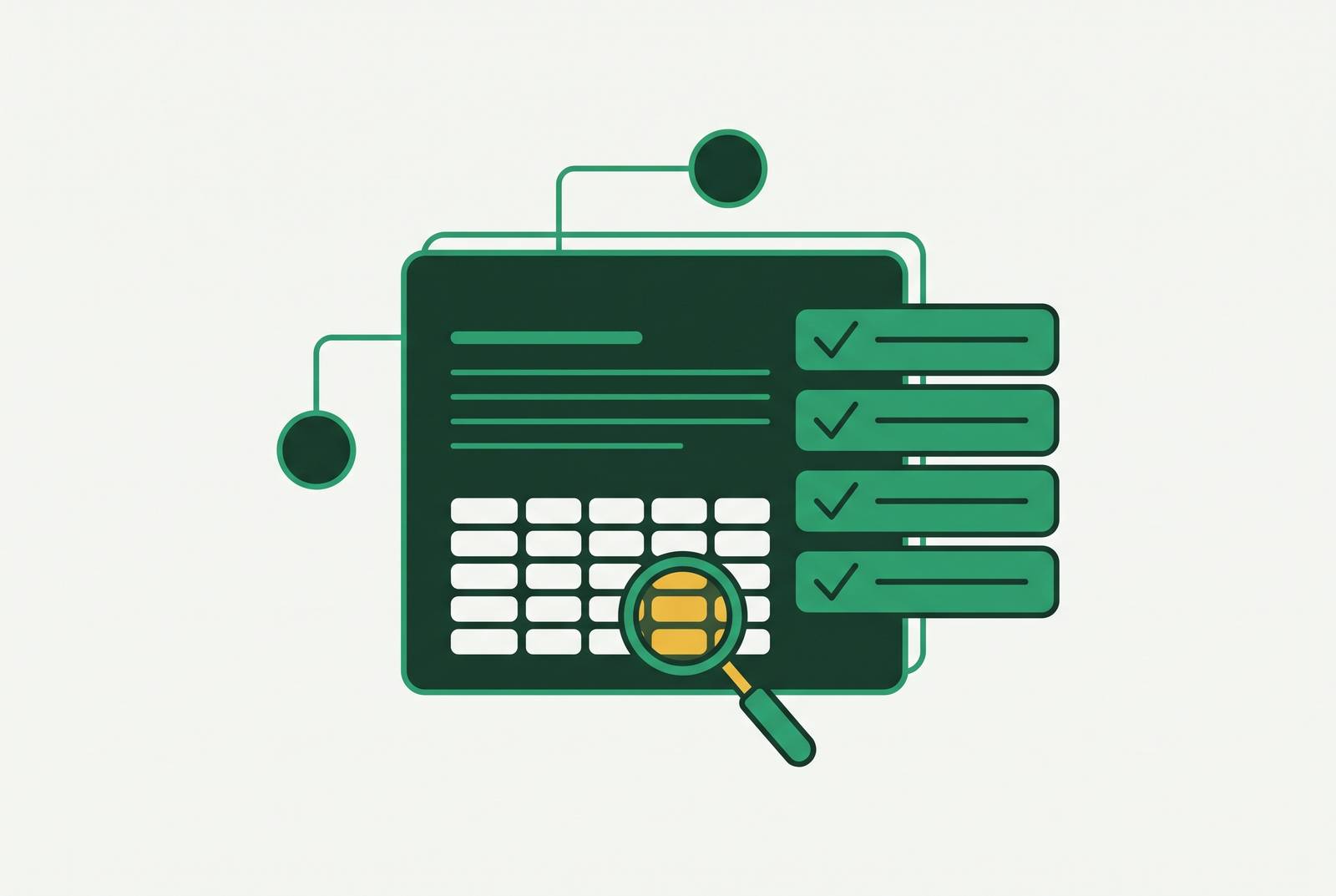
A team has a wiki page titled "Data Quality Standards." It was written eighteen months ago, it has not been edited since, and when a pipeline breaks at 2am, nobody opens it. This article is about why that happens and what a wiki entry has to contain to avoid it: the failure in most data quality documentation is not that it's absent, it's that its form makes it unenforceable. An AI agent modifying a pipeline cannot respect a constraint it has no way to read, so the undocumented expectation does not function as a constraint. It simply does not exist.
This matters more now than it did five years ago, because AI-assisted tooling can update a spec or refactor a pipeline in minutes rather than days, leaving far less time for an implicit rule to surface before it breaks something. The gap between what a team believes it has documented and what is actually enforceable widens every time a rule stays implicit.
A second failure mode compounds the first: documentation written at a level of abstraction so high that it cannot be tested. "Data should be accurate and complete" is a sentiment, not a standard. Data sources change constantly. A rule written when a pipeline had one upstream source will fail silently the day a second source is added, and a wiki that does not track when a rule was last checked against reality has no way of knowing the failure happened.
Defining "good data" in testable terms
A data quality expectation earns its place in a wiki only if it can produce a binary result: the data meets it or it doesn't. That requirement forces a shift in how "good data" gets defined. Rather than a single vague standard, good data breaks down into distinct dimensions, each of which maps to a specific kind of check.
Accuracy means the data reflects reality: a phone number that reaches the person it's attached to, a deal amount that matches the signed contract. Uniqueness means no duplicate records are silently inflating counts or splitting history across two IDs. These six dimensions, accuracy, completeness, consistency, timeliness, validity, and uniqueness, are the core categories that organize data quality work, and each gives a documented expectation something specific to test against.
Consider: "The account_industry field must be populated and must match the controlled picklist" is an expectation against validity and completeness, and a validation rule can test it automatically with no human judgment required. Without it, two teams will write contradictory rules for the same field, each correct by its own definition and useless to the other.
The anatomy of a wiki entry that enforces a standard
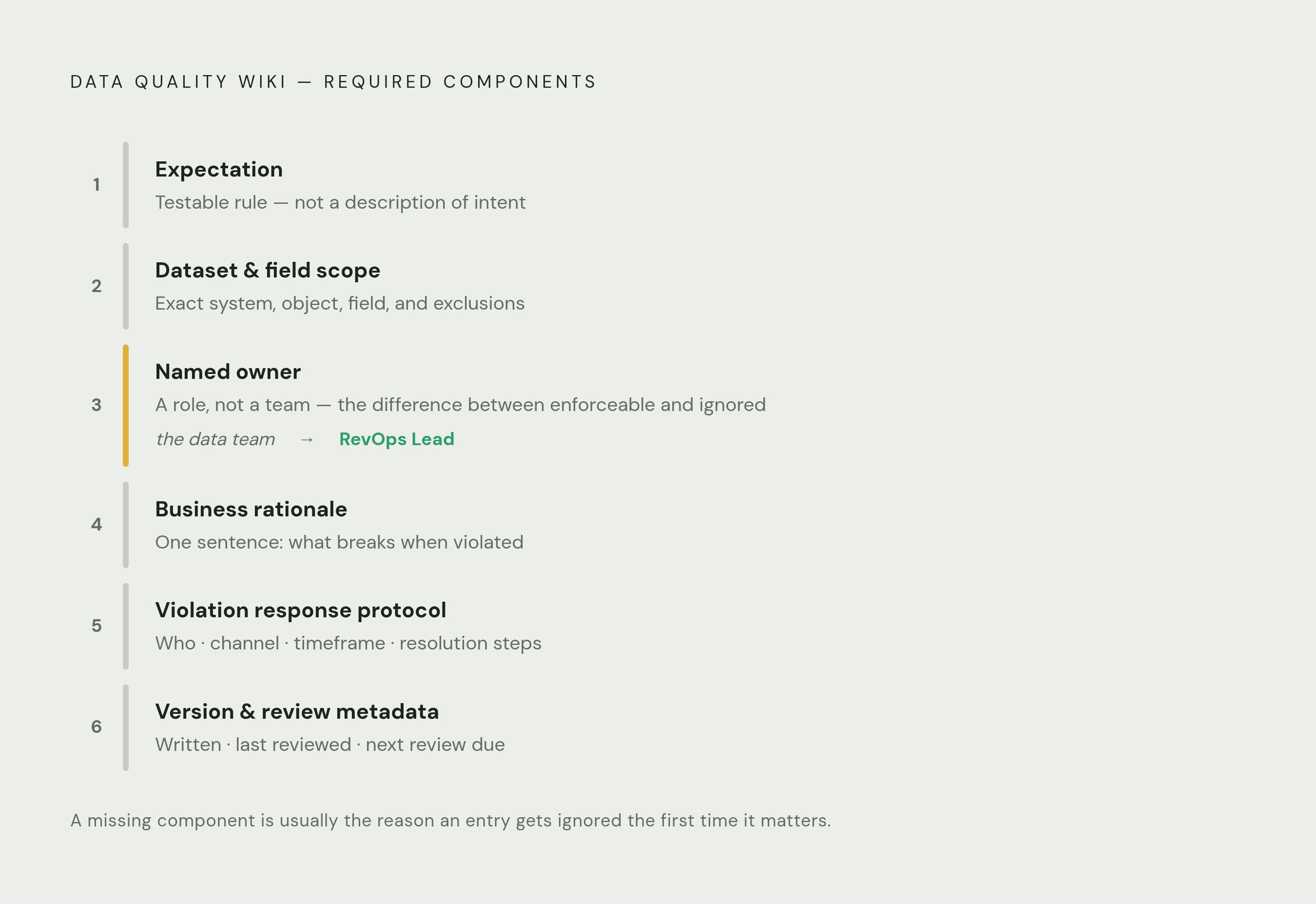
A wiki entry that functions as an enforceable standard needs six components, and a missing component is usually the reason an entry gets ignored the first time it matters.
| Component | What it contains | |---|---| | The expectation | Stated as a testable rule, written in terms specific enough to translate directly into a validation check, not a description of intent | | Dataset and field scope | The exact system, object, and field the rule governs, plus any scope exclusions ("applies to inbound leads, not to imported historical contacts pre-2024") | | Named owner | A role, not a team: "RevOps Lead" is actionable, "the data team" is not | | Business rationale | One sentence explaining what breaks when the rule is violated, so a future engineer doesn't delete a rule they don't understand | | Violation response protocol | Who is notified, through what channel, within what timeframe, and what the resolution steps are | | Version and review metadata | When the rule was written, when it was last reviewed, when it's due for its next review |
The business rationale line does more work than its length suggests. Every one of the six fields above exists because an automated system or a human reader will need it at the exact moment something goes wrong, not before.
Organizing a wiki so expectations are findable and cross-referenced
Well-written entries still fail if the wiki's structure buries them. The first organizing decision is to group by business domain, not by quality dimension. A team navigating the wiki during an incident is thinking "I need the rules for contact records," not "I need every completeness rule in the company," so a CRM contact index, a pipeline stage index, and a financial transactions index serve the reader far better than a page sorted by accuracy, then completeness, then validity.
A unified data dictionary should anchor the whole structure.
Cross-referencing has to run in both directions. Each wiki entry should link to the validation rule, automated check, or monitoring alert that enforces it, and each of those enforcement artifacts should link back to the entry. A status taxonomy makes the whole system legible at a glance: tag each entry Draft, Active, Under Review, or Deprecated, so a reader knows immediately whether to act on what they're reading or treat it as history. A single index page per domain, listing every active expectation, its owner, its last-reviewed date, and its status, becomes the page a team lead or auditor scans to assess the health of the documentation itself, separate from any one rule within it.
Assigning ownership so accountability is real rather than nominal
Ownership written into a wiki entry means little unless the named owner understands what they're accountable for, has the authority to fix a violation, and is actually reviewed on the outcome. Two failure modes show up constantly: under-distribution and over-distribution. Over-distribution does the opposite, giving every field a separate owner with no coordination layer, so inconsistencies that span two fields fall into the gap between two people who each think the other is watching.
The producer-consumer model resolves most of this. The team that produces the data owns the expectation, because they're the only party positioned to prevent a violation at the source. Without a producer-consumer split, each of the three assumes one of the others is responsible for field-level quality, and all three are wrong simultaneously.
A data steward closes that gap. And because people change roles and teams reorganize, owner confirmation has to be a required step in every scheduled review. A stale owner assignment routes violations to someone who no longer has the context or the authority to resolve them, which functions as no owner.
Building a violation response protocol that gets used under pressure
A monitoring alert fires at 11pm. A violation that's detected but not resolved inside a defined window produces the same downstream damage as a violation that was never detected.
A usable response protocol specifies four things. And it requires root-cause documentation after every violation: what caused it, and whether the expectation or the upstream system needs to change. That last requirement is the feedback loop that keeps the documentation honest over time.
Severity tiers make triage consistent. The protocol is what connects the wiki to the monitoring system in practice: each expectation's entry should name the alert that tests it, and the alert's configuration should link back to the entry and its protocol. The wiki's protocol should specify which categories of violation are candidates for that kind of autonomous resolution and which still require a human to confirm before anything changes.
Preventing drift: the review cycle that keeps documented expectations current
A rule with no review date is the stale artifact described at the start of this piece, and a review cycle resolves that problem. Schema drift, structural changes in the data that break downstream processes, is one of the most common causes of an expectation going obsolete, and it stays invisible unless the wiki is connected to a change-notification process that surfaces it.
Beyond those triggers, a scheduled review should walk through a fixed checklist for each entry: does the rule still reflect the current data source, is the owner still the right person, is the severity tier still accurate, and has the violation rate over the past quarter revealed anything about how precise the rule actually is. One embedded into an existing rhythm, a sprint review, a quarterly planning session, a governance meeting, becomes part of how the team already operates, and assigning review of the expectation index as a standing agenda item keeps it from becoming an afterthought.
Every change to an entry should be versioned: what changed, who changed it, why, and when.
Choosing where the wiki lives
The platform a team picks for its wiki decides whether documented expectations stay connected to the systems enforcing them or drift into a parallel layer nobody consults when something actually breaks. The one non-negotiable requirement, regardless of whether the team uses a dedicated data catalog, an internal wiki platform, or documentation embedded in a code repository, is that each entry can be linked directly from the monitoring alert, the validation rule, or the automated check that tests it. A wiki that can't be linked from the tool firing the alert gets consulted after the fact, once the team is already under pressure and least likely to follow the protocol it describes.
Where possible, the data dictionary itself should live in a structured, machine-readable format rather than purely as prose, because standardized schemas enforced through automated validation stay reliable in a way that human-maintained text alone does not. The wiki is the human-readable source of truth and the validation rule is its machine-readable enforcement; the two have to describe the same thing, and any divergence between them is a data quality problem to treat as seriously as a bad record.
A hybrid monitoring model works best in practice. The most advanced version of this stack closes the loop further still: AI agents that continuously monitor against documented expectations, detect deviations, and propose or apply fixes without waiting for a human to triage the alert first. That level of operation is only possible once the documentation underneath it is accurate enough to trust.
A model doesn't know a field is unreliable; it scores against whatever value sits in the record.
CRM data also decays faster than most datasets. A confidently wrong forecast or a mis-scored lead is the default outcome of a data standard that was never written down or never updated.
Applying the framework to specific fields makes it concrete. Contact completeness should specify which fields are required for a contact to be workable by sales, not an aspirational list of every field that could exist, but the specific ones without which the next action can't be taken. Account classification should document the valid values for industry, company size, and segment, who owns the picklist, and what happens to a record that arrives with a value outside it. Pipeline stage validity should state the conditions that must be true before a deal can occupy a given stage, and who owns confirming those conditions are met before the record advances. Duplicate detection should define what counts as a duplicate contact or account, and who is responsible for confirming and merging when the monitoring system flags one.
The leading RevOps teams are building formal governance with canonical definitions for every revenue object in the CRM, enrichment and deduplication built into data entry itself, regular audits, and a live data quality score reported to leadership alongside pipeline metrics. That governance depends entirely on the documentation that produces it. The wiki is the prerequisite that makes automated enforcement, and eventually autonomous remediation, something a team can trust.
Getting the wiki adopted: turning a document into a team practice
A wiki can be complete, well-structured, and correctly linked to every validation rule in production, and it will still fail if the team never actually consults it. Adoption has to be designed.
The documentation has to be closer to the work than the problem it describes. Requiring each domain owner to author or formally ratify the expectations in their own domain makes the ownership named in section three real.
A shared quality metric sustains engagement once the initial documentation effort is done. A data quality score, derived from the violation rate across documented expectations, gives leadership a visible read on the health of the whole framework and gives teams something concrete to improve against. Every violation that exposes a gap, an unowned expectation, a missing protocol, a rule that never anticipated an edge case, should produce an update to the wiki itself, not just a fix to the underlying data. That's the practice that keeps the documentation alive between scheduled reviews.
The standard is simple to state. When a new engineer joins the team and reads the wiki, they should understand what good data looks like in each domain, who's accountable for it, and what to do when a violation occurs, without asking anyone. When an AI agent tests against a documented expectation, it should find a current, versioned, unambiguous rule, not a page last updated before the upstream schema changed underneath it. That is the bar a team wiki has to clear to be called a living contract.