Deduplication Tool Evaluation Criteria for M&A Data Teams Inheriting a Foreign CRM
A practical test plan for choosing CRM deduplication tools after an acquisition.

CRM data quality for M&A integration calls for tools tested on cross-system identity as well as routine database hygiene. Teams inheriting a foreign CRM must first decide where deduplication will happen, then test matching, field-level survivorship, rollback, and audit evidence on their own data. The right evaluation covers both the initial consolidation and the prevention of new duplicates after integration.
Why standard deduplication fails when two CRMs meet at an acquisition
Routine deduplication assumes a stable schema, consistent lifecycle stages, and a canonical identity for each entity. An acquisition breaks those assumptions at once. MQL, SQL, and Closed Won can mean different things in each organization, and account hierarchies and field standards show how each has worked in the past. Automation rules that worked independently can conflict when the datasets meet.
Reconciling identity is the deeper difficulty: the same customer can have a different company name, domain, owner, and record ID in each CRM. A fuzzy name match cannot reliably reconcile those differences, particularly when one organization records legal entities and the other uses trading names. Joining two imperfect datasets compounds their existing duplication, so a tool suited to monthly hygiene in a stable organization is not necessarily suited to an acquisition.
What breaks downstream when cross-system duplicates go unresolved
Cross-system duplicates distort the consolidated view that leadership needs during integration. When the same opportunity appears under different names or owners, pipeline reports count it twice. Duplicate prospect records can also route the same person to representatives from both legacy organizations. Disputes over ownership then reach the customer as well as the teams managing the records.
AI makes the problem harder to contain. Scoring, next-best-action, and forecasting tools ingest CRM data as ground truth, so duplicated entities systematically distort their outputs. Those errors are directional and difficult to detect afterward.
Consent and cost create further business exposure. A contact who opted out in one system may remain active in the other, allowing outreach to continue through the surviving duplicate. That creates customer experience failures and exposure under GDPR and similar frameworks. The extra records also use storage and enrichment API calls, and in some cases affect seat-tier costs.
The architectural decision that must come before tool selection
Before evaluating vendors, the team must decide whether deduplication will happen inside one system of record or across two live CRMs. Scope determines which tools can do the job. Salesforce Duplicate Management and HubSpot’s AI-assisted dedup operate within their own platforms, so neither can see, match, or merge records in a different CRM. During parallel operation, each can clean only its own side.
A single-CRM destination changes the requirement but does not remove it. The tool the team chooses must catch duplicates during the import as well as after migration. The surviving platform should ideally be decided before tooling, with data residency reviewed at the same gate. Native CRM apps keep data inside the organization’s CRM environment, while API-based tools move records to an external service for matching.
Tool categories also represent different scopes. Deduplication, validation and standardization, enrichment, monitoring and alerting, and capture-at-source address different parts of the integration problem. Treating them as interchangeable can produce a purchase that fails because its remit was wrong.
Match rule flexibility: why weighted, multi-field, cross-object scoring is non-negotiable
Matching must identify entities whose identities were encoded differently. One CRM may store email on a contact, while another represents the account through its domain. Phone formats and address layouts may also differ. Weighted, multi-field, cross-object matching is therefore a foundational criterion, because exact matches and simple fuzzy names miss relationships across those structures.
A domain match can receive more confidence than a company-name match, while name, domain, phone, and city together can identify near-duplicates missed by individual fields. Phonetic or ML-based matching handles patterns of spelling variants that come from different ways of entering data. Cross-object support is equally important because the same person can exist as a Lead in one record and a Contact in another.
The team should run a fifty-record sandbox test with records known to belong to the same entities in both systems. Recall on that sample is more useful than a vendor benchmark. Insycle is relevant when HubSpot and Salesforce remain live, offering configurable rules and coordinated cross-CRM deduplication through a sequential two-step process. DataGroomr uses AI-based matching for messy data that defeats rule-based approaches.
Merge logic and survivorship: deciding which record wins field by field
Finding a duplicate does not establish which values deserve to survive. Neither source is authoritative by default in an acquisition. The acquired CRM may have better enrichment, while the acquiring CRM has more reliable ownership data. A blanket rule that keeps the older or more complete record cannot express that distinction.
Field-level survivorship must therefore be a pass/fail criterion. Rules should select values by recency, completeness, or the system designated authoritative for that field type. DemandTools provides field-by-field surviving-record control for controlled Salesforce bulk merges, while Insycle supports field-level master record selection with bulk operations. Custom objects and unmatched fields also need explicit handling so that data present on only one side is not silently dropped.
Rollback is another pass/fail test. A decision made at day 30 may turn out to be wrong when the team learns more at day 60. The tool must keep merge history and let the team reverse a decision after it has carried it out. Without built-in rollback, a mistaken bulk merge is not an undo button away.
Audit log depth and the compliance exposure specific to acquired data
Acquired personal data arrives with the collecting company’s consent history and potentially a different legal jurisdiction. A merge must preserve the relevant evidence. If an opted-out record is retired while an active record survives without its restriction, the resulting outreach can violate the original consent. The audit trail must show what happened to that restriction at the field level.
A sufficient log identifies the records merged, their field values before and after, the triggering rule or scenario, the executing user or automated agent, and the timestamp. “Merge executed” is not enough for compliance review. GDPR and similar frameworks require organizations to demonstrate a lawful basis for processing personal data. Combining datasets may require that basis to be re-established or at least documented, with the audit log serving as evidence of what changed.
The team should review a sample vendor audit log before it buys the tool. Its contents should show the field-level changes, rule, and actor rather than merely confirm that an operation occurred. This test separates operational activity tracking from evidence that supports a review of acquired data.
Batch and ongoing deduplication modes: the initial cleanup is not the end of the problem
The first batch may have tens of thousands of records, so the team needs configurable survivorship, a preview before it runs the batch, and scheduled jobs that let it do the work in stages. Completing that run does not stop new duplication. Forms, webinar registrations, list imports, enrichment syncs, and further migration events continue to introduce records.
Prevention must operate where those records enter. Cloudingo’s import deduplication is designed to catch duplicates at load, while scheduled scans can find records that slip through prevention rules. Real-time checks catch duplication at creation but add latency to sync workflows. Batch cleanup is retrospective, so the evaluation should establish how both modes can be configured for different entry points.
Agentic monitoring offers a different approach to the interval between scans. An agent can continuously watch for duplicate signals and propose or apply fixes without waiting for a scheduled job or human-triggered review. That architecture addresses the re-contamination loop rather than treating each recurrence as another cleanup project. It is especially relevant when ongoing manual triage would undermine the integration team’s ability to sustain quality.
External validation and enrichment as a cross-system consistency layer
Two incorrect records do not become correct through merging. Each organization may have used different enrichment providers and updated its data at different times, so even the newer value may be out of date. External validation establishes a baseline beyond the competing source records. The team should check email deliverability, phone format and line type, postal address standardization, and company firmographics against a third-party business database.
Standardization also improves the matching that precedes a merge. Expanding “St.” to “Street” and standardizing country codes reduces false negatives caused by formatting differences. Address verification and CASS validation for US addresses are distinct capabilities, however, rather than automatic consequences of having a matching engine. Evaluators should establish whether the tool performs them natively or needs a separate integration.
Enrichment must cover the markets the acquired company serves. A provider that serves the acquiring company well may leave systematic gaps in unfamiliar industries or geographies. The practical test is to run merged sample records through the validation layer and compare bounce rates and address match rates against known-good records. Vendor-curated samples cannot establish performance on the inherited dataset.
Cost model evaluation when the database size is unknown at purchase
The final record count is unknown until deduplication is complete. The team needs to check pricing before it can give a reliable estimate of how many records it will have. DemandTools uses per-seat pricing, which can be predictable but poorly aligned with a project operated by a small data team. Paid coverage needs to correspond to actual use.
Per-CRM-org pricing shifts the calculation toward a more knowable quantity. Cloudingo offers tiered annual pricing per Salesforce org through Standard, Professional, and Enterprise tiers. Per-record pricing instead exposes the buyer to uncertainty in the combined database size. Where billing uses the pre-cleanup count, the team pays to process duplicates that the tool will eliminate, so negotiation based on post-deduplication volume is worth pursuing where possible.
Project pricing addresses a different requirement again. Verum offers managed deduplication with an export-and-return process and human QA, making it relevant to a one-time deep clean without an ongoing license. That model does not cover daily prevention. Configuration, training, rule maintenance, and correcting false-positive merges must also enter the comparison, because the license alone does not express total cost.
A sequenced evaluation process for the integration timeline
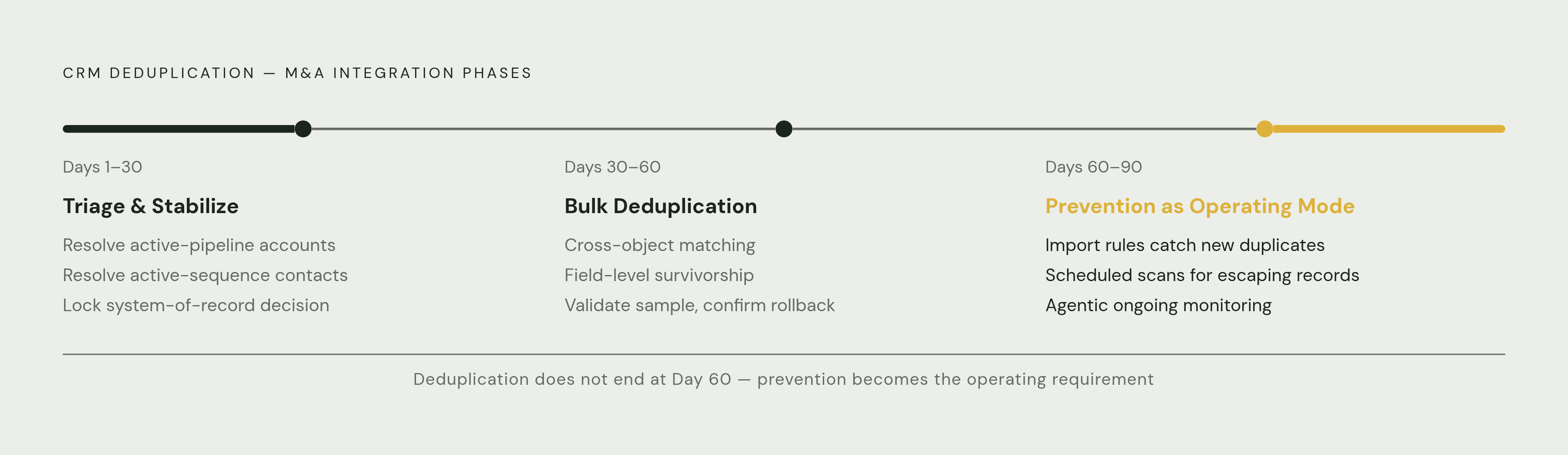
During days 1–30, the priority is triage and stabilization. The team should find accounts that have active pipeline in both systems and contacts that are in active sequences in both organizations. The team should resolve those high-impact clusters by hand or through a targeted batch before it starts broad automated deduplication. This is also the period for locking the system-of-record decision.
During days 30–60, the focus shifts to the unified data model and bulk deduplication. With the destination CRM decided, the imported dataset needs cross-object matching, field-level survivorship, and a full audit trail. A sample should be validated before the full run. Rollback must also be confirmed before execution at scale, rather than discovered as a missing capability after an incorrect merge.
During days 60–90, prevention becomes the operating requirement. Import rules should catch new duplicates at load, with scheduled scans covering records that escape those checks. Automations can then be rebuilt on the clean unified dataset and consolidated pipeline reporting established. Ongoing monitoring, ideally agentic rather than alert-only, addresses the continuing work beyond migration.
Matching flexibility and cross-object support are pass/fail for consolidation, while merge control and audit depth are pass/fail for defensible handling of acquired data. Validation, operating modes, and pricing distinguish tools that fit the full integration from those suited only to its cleanup window. Teams that cannot keep up manual governance afterward must assess continuous monitoring as part of how the system will run, before duplication returns.