Reconciliation Query Patterns for Merging Two Customer Databases
Resolve customer identity at ingestion time to prevent downstream systems from conflicting.

Merging two customer databases after an acquisition requires a sequence of reconciliation query patterns. Reliable CRM data quality for M&A integration starts with source inventory, standardisation and blocking, then moves through matching, survivorship and parent-first merging. The controlling decision is to resolve identity at ingestion time, so downstream systems retrieve one current customer context.
Why two customer databases rarely share a common key — and why that makes naive joins fail
One database stores “Jennifer A.” in separate first-name and last-name fields, while the other stores a full name with a salutation. An exact comparison cannot bridge that format difference. Match Data Pro describes this mismatch as a cause of missed matches between customer databases. Address fields compound the problem when one estate follows USPS standards and the other contains free text entered by sales representatives.
Identifiers create a deeper obstacle than formatting alone. Tilores explains that CRM contact IDs, billing IDs, account numbers and marketing contact IDs originate in local workflows. An exact email join catches obvious overlaps but misses customers who changed roles or used a personal address in one system and a work address in another. Conversely, a shared household phone or billing address can make distinct people appear identical, while a parent company or reseller can connect distinct businesses. Email therefore serves as identity evidence rather than a shared primary key, and a join can still be wrong even when an email is present or matches exactly.
Why resolving identity at ingestion time rather than query time is the controlling architectural decision
Identity must be resolved when records enter the combined estate. Each new or changed record enters a central identity layer, and query-time requests get the current resolved context without running the matching process again. Otherwise, a CRM, warehouse job and support tool can disagree about whether two records represent the same customer. A workflow can also receive stale context because its source synchronised overnight.
This identity layer has a defined, limited purpose. It decides which records describe the same person, household, account or organisation, then exposes that context to consuming systems. It does not replace a full master-data operating model. Governance, warehouse, activation and master data management systems use the resolved context and still do their own jobs.
Source inventory — mapping both estates before writing a single match rule
Ingestion-time resolution begins with a map of both estates. The inventory identifies which systems create, update and consume customer records, which identifiers they assign, and who owns each record type. It covers CRM contacts, leads and accounts, billing customers, support users and marketing contacts. Consent fields, product identifiers, customer numbers and historical merge IDs belong in the inventory too, because they provide context that a contact-only extract omits.
Schema reconciliation establishes whether the expected tables, columns, mappings and data types exist. FirstEigen distinguishes reconciliation at schema, count, aggregate, record and field levels, with schema as the foundation. Profiling then measures field completeness and examines name formats, date formats, phone standards and address conventions. These distributions determine which fields are reliably populated enough to support matching. A rule built around a sparsely populated field cannot provide the coverage its design assumes.
Source ownership also limits what can safely be combined. A sales territory, billing status, risk flag or consent value may be right for one source but unsuitable as a customer attribute for all sources. Preserving that distinction prevents the inventory from becoming a premature exercise in flattening every record into one profile. The output is a source map showing ownership and update paths, together with a shared identity evidence model. That model identifies which fields can support a match, split or review decision.
Standardisation — normalising name, address, phone, and email fields before any comparison runs
Full names are parsed into title, first, middle, last and suffix components, with salutations removed from the comparison values. This aligns a single full-name field with an estate that stores separate first-name and last-name columns. Address standardisation expands abbreviations such as St to Street, Ave to Avenue and Ste to Suite. CASS-certified software verifies and standardises addresses against the USPS postal database, addressing differences that would otherwise depress similarity scores.
Phone standardisation removes formatting characters and separates extensions into their own field. “(602) 555-0100” and “6025550100” must become the same comparison token. Email standardisation lowercases values and removes trailing whitespace, while disposable-domain addresses receive lower match weight. Without these steps, differences in representation become apparent differences in identity.
Validation checks whether a value meets a format, range or type rule. Matching finds which records correspond, and reconciliation checks whether those records agree. A correctly formatted phone number does not establish that two customers are the same, and a confirmed match does not establish that their profile fields agree.
Blocking — partitioning the candidate space so fuzzy matching runs at scale
Blocking narrows the pairs that proceed to similarity scoring. Comparing every record in one estate with every record in the other is computationally infeasible at enterprise scale. Candidate groups bring together records that could be connected, ruling out most impossible pairs before fuzzy matching begins. Match Data Pro describes this partitioning as a way to make matching tractable across millions of records.
Email domain is one useful key because records that share @acmecorp.com can become candidates even when their names differ. The final four digits of a normalised phone number provide another grouping when names differ. Soundex groups phonetically similar surnames, including “Smith” and “Smyth” or “Garcia” and “Garsia”. No single pass captures every plausible relationship. With overlapping passes, a pair missed by a ZIP-and-surname block can still enter through an email-domain block, increasing recall while keeping the candidate set manageable.
How do you deduplicate customer records when merging two CRMs after an acquisition?
Deterministic matching resolves exact matches on reliable identity fields first. Email, phone and account ID can identify high-confidence overlaps where the source evidence supports their use. Their reliability must come from the inventory, because shared phone numbers and locally assigned account IDs remain ambiguous. Resolved pairs then leave the probabilistic candidate pool.
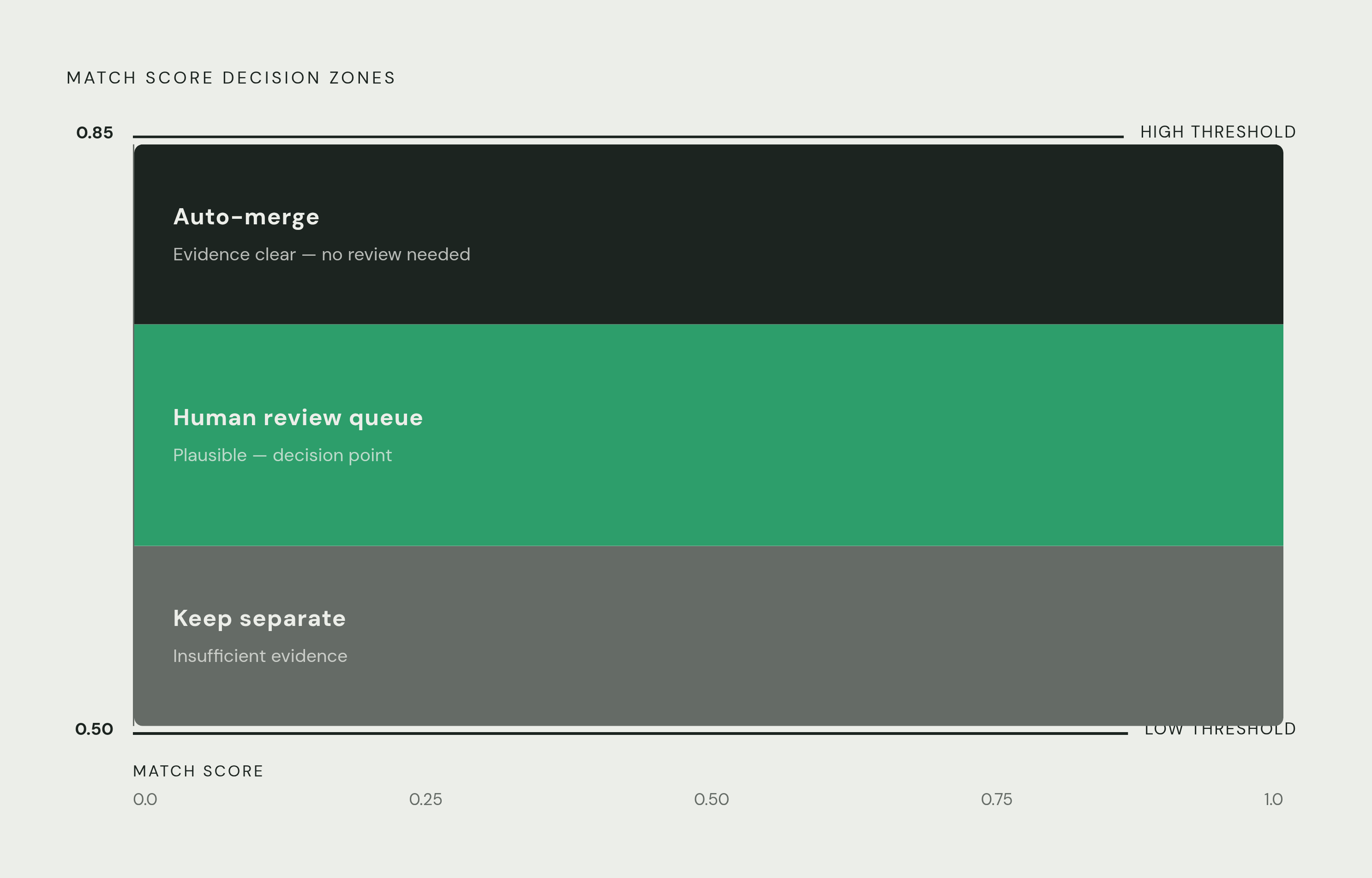
Probabilistic and fuzzy matching work on the candidate pairs that are left. They evaluate evidence that does not produce an exact match, after standardisation has removed avoidable formatting differences. Jaro-Winkler provides a similarity measure for name comparisons, but an algorithmic score still requires an operational decision rule. The threshold model supplies that rule. Its purpose is to distinguish evidence strong enough for an automatic merge from evidence that requires judgment or does not justify merging.
Above the high threshold, the pair is auto-merged because the evidence is strong enough that human review adds no value. Between the thresholds, the pair enters a human-review queue because the match is plausible but uncertain. Below the low threshold, the records remain separate because the evidence is insufficient. These are three distinct dispositions.
Match rules also need to be tested against schema-change events. A renamed field or deprecated type can silently break logic that previously worked, even when the underlying customer population has not changed. Tests that check only data distributions miss this way in which the rules can break. Once a pair passes the matching decision, a separate question remains. The system must determine which conflicting field values belong on the resolved record.
Survivorship rules — determining which field values survive onto the golden record
A golden record can take its legal name from the ERP, its phone from the CRM and its address from an enrichment source. Source-priority rules designate authority for each attribute, allowing a legal name to survive over a marketing nickname without making the ERP authoritative for every field. Matching establishes that the records describe the same customer. Survivorship constructs the profile from their sometimes conflicting values.
Recency, completeness and trust provide other selection rules. Most-recent-wins favours the newer timestamp and suits frequently changing fields such as phone and address. Most-complete-wins favours the more populated or longer value where completeness is the reliability signal. Trust-score-based selection uses the confidence given to a source and works well when reliability differs by data type. These strategies make the choice explicit rather than leaving the system to select arbitrarily or fail the merge.
Some source-specific fields should not merge at all. Sales territory, billing status, risk flags and consent values can retain meanings that depend on their originating system. Tilores describes the required output as a governed customer view with evidence and paths for splitting, merging, access and deletion. Without that context, the golden record becomes another master record that consumers lack enough evidence to trust.
Merge sequencing — resolving parent records before child records
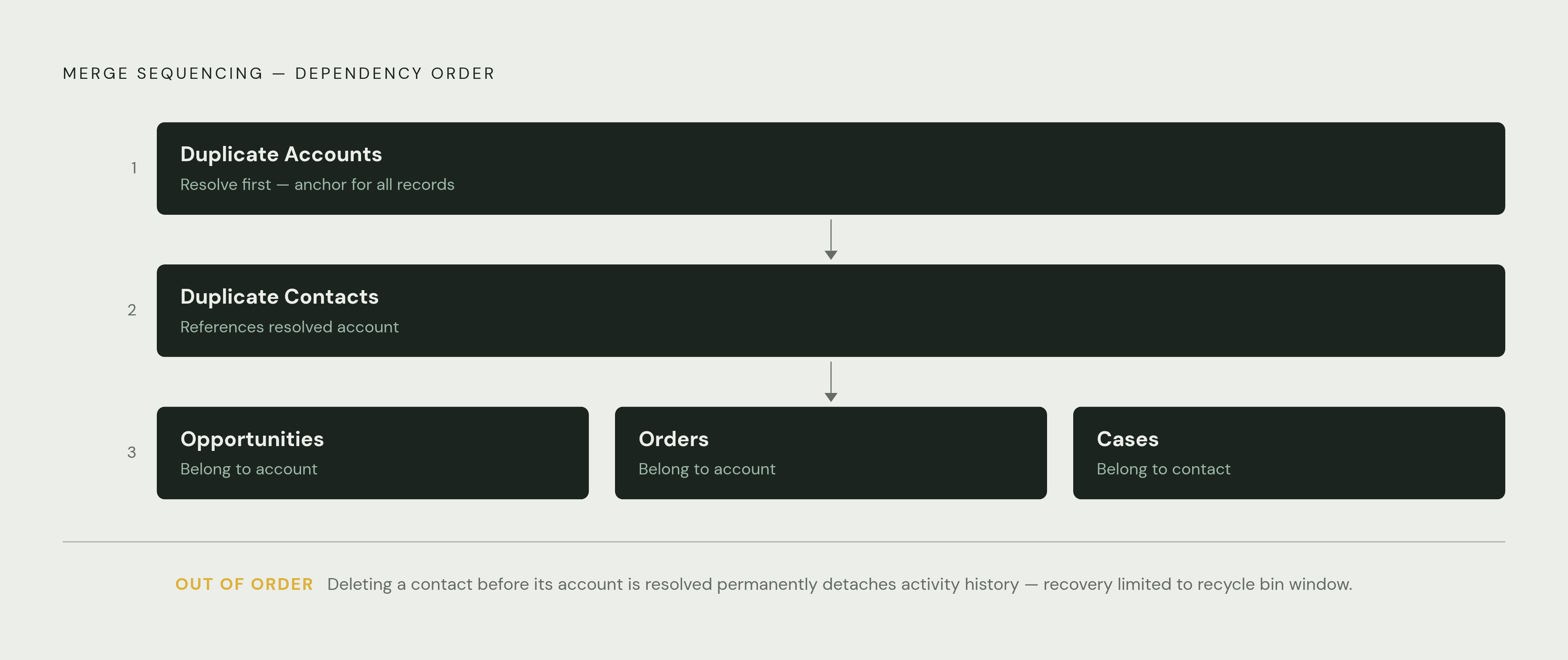
Deleting a duplicate contact before resolving its account relationship can detach its activity history permanently. Survivorship rules cannot reconstruct history that the operation has lost. Recovery may be limited to a short recycle bin window, which varies by platform. The correct parent must be in place before the system decides which child record survives.
In CRM reconciliation, duplicate accounts are therefore resolved before duplicate contacts. The contact decision can then use the resolved account relationship. The same dependency applies to other record types. Opportunities and orders belong to accounts, while cases belong to contacts. Each layer waits for the layer above it so that the merge does not settle a child record against an unresolved parent.
Timestamp reconciliation is the final check after each merge batch. Comparing maximum or minimum timestamps between source and target systems tests whether the target is current. A completed transfer can still leave consumers with stale information. This freshness check applies the ingestion-time principle to each merge, because the resolved context must keep up with changes after the migration snapshot is complete.
What downstream systems receive — a single resolved customer context and why it must be maintained continuously
Downstream systems get an entity ID, the source records that contributed to it, the chosen profile fields, match evidence and lineage. That package is the resolved customer context. CRM, billing, support and AI workflows retrieve it instead of independently reconciling raw source records. The evidence explains the relationship between the source material and the selected profile. The entity is therefore usable as a shared context without concealing how its identity and attributes were established.
Maintaining that context continues after the acquisition merge closes. Added columns, renamed fields and deprecated types can break reconciliation logic after it is first put to use. Ongoing schema monitoring helps catch that risk, while entry-point controls, automated deduplication and validation check the quality of data as it comes in. RevOps teams can track completeness, accuracy and decay rate as a regular data integrity metric alongside their pipeline metrics. Those measurements show whether the data behind downstream reporting can still be trusted as records change.
AI agents make this ongoing discipline especially consequential. An agent acting on a duplicated or incorrect customer record repeats the identity error at machine speed. Its automation does not repair the evidence it receives. For agentic workflows to be trusted, the identity layer must be kept up to date and supply current, resolved customer context before the agent acts.